Modified Clinical Test of Sensory Integration on Balance CTSIB (mCTSIB)
Description
The bedside Modified Clinical Test of Sensory Integration on Balance (mCTSIB), also known as the CTSIB-M, is the quickest and easiest variation of the CTSIB assessment to perform, consisting of only four test conditions and only requiring a foam balance pad to perform.
Although performing the assessment is quick and easy, it is important to recognize the limitations of its ability to detect more subtle abnormalities due to its lack of objective postural assessment and limited control over the patient’s visual inputs.
How to perform the mCTSIB
To perform the mCTSIB, the patient is instructed to stand upright with their feet roughly shoulder-width apart and their arms crossed in front of their chest, or at their side. The patient’s goal for this assessment is to maintain this standing position for 30 seconds in each of the four test conditions. The four conditions of the mCTSIB are:
- Eyes open, firm surface
- Eyes closed, firm surface
- Eyes open, foam surface
- Eyes closed, foam surface
The primary measure for the mCTSIB is the number of seconds that the patient can hold the test position in each condition. The trial is considered over when any of the following occur:
- The patient opens their eyes (in conditions 2 and 4).
- The patient moves their arms from the test position to stabilize themselves.
- The patient requires manual assistance from the examiner to prevent a fall.
- The patient successfully maintains the test position for 30 seconds.
The patient has three attempts at each condition but can move on to the next condition straight away if they manage to maintain the position for 30 seconds.
Interpretation of the mCTSIB
When interpreting the bedside mCTSIB, the primary outcome of interest is which conditions the patient ‘failed’ by not successfully maintaining the test position for 30 seconds. Below are some of the common patterns of results you may find in clinic and what they could suggest.
Pattern one: Failure in eyes closed conditions (1 and 3)
| Firm surface | Foam surface | |
| Eyes open | Passed | Passed |
| Eyes closed | Failed | Failed |
Potential indication: Patient is ‘visually dependent’, or patient is not effectively using their vestibular/somatosensory inputs.
Pattern two: Failure in foam surface conditions (3 and 4)
| Firm surface | Foam surface | |
| Eyes open | Passed | Failed |
| Eyes closed | Passed | Failed |
Potential indication: Patient is not effectively integrating their visual and/or somatosensory inputs.
It is important to remember that the mCTSIB should only form one part of your overall assessment and further diagnostics are required to confirm any diagnosis.
mCTSIB vs traditional CTSIB vs CTSIB VR
Compared to the mCTSIB, the traditional CTSIB adds two conditions with sway-referenced vision on both the firm and foam surfaces, historically deployed with a ‘visual-conflict dome’ (Figure 1). The visual-conflict dome is intended to provide a secondary means to control the patient’s visual input to assess the impact upon their postural stability.
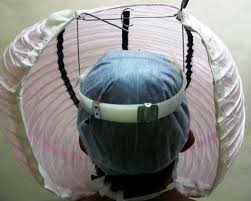
With advancements in technology have also come advancements in the validity and accuracy of the CTSIB assessment procedure. Virtual reality has given us far more advanced levels of control over a patient’s visual inputs than has previously been possible. By combining virtual reality with the enhanced level of objectivity and accuracy of posturography, the Virtualis CTSIB takes the test to the next level of diagnostic power. This is called CTSIB VR.
The most significant difference in terms of the testing technique with CTSIB VR is the use of a virtual reality goggle instead of a visual-conflict dome to deliver sway-referenced vision. With the goggle attached firmly to the patient’s head, it is easy to achieve the visual-conflict effect as the virtual reality goggle provides a visual stimulus which covers the patient’s full visual field.
Table 1 summarizes the differences between mCTSIB, traditional CTSIB, and CTSIB VR.
| mCTSIB | Traditional CTSIB | CTSIB VR | |
| Number of conditions | 4 | 6 | 6 |
| Sway-referenced vision | No | Yes | Yes |
| Visual-conflict method | No visual conflict | Low-tech visual-conflict dome | VR goggle covering the full visual field |
| Objective posturography | No | No | Yes |
Table 1: mCTSIB vs traditional CTSIB vs CTSIB VR.
Read more: CTSIB using virtual reality and posturography
References
Khattar, V. S., & Hathiram, B. T. (2012). The clinical test for the sensory interaction of balance. International Journal of Otorhinolaryngology Clinics, 4(1), 41–45.
Presenter