8 reasons why you should include ACT™ in your clinical test battery
Two and half years after its launch, the Audible Contrast Threshold (ACT™) test is moving from novelty to everyday clinical practice. Designed to predict a client’s aided hearing-in-noise performance, ACT is helping hearing care professionals uncover challenges that traditional tests often miss – and does so in one to three minutes.
Are you yet to use ACT in your clinic? Then here are 8 reasons why it deserves a place in your clinical test battery.
1. ACT predicts hearing-in-noise ability
ACT is the first clinically applicable test developed specifically to predict aided hearing-in-noise performance. By measuring a client’s ability to detect spectro-temporal contrast, it provides insight into real-world listening challenges – not just hearing thresholds.
2. ACT supports more personalized hearing aid fittings
You can program the results of the ACT directly into your client’s hearing aid either manually or automatically, providing the hearing-aid user with an objective and personalized fitting based on their hearing in-noise ability.
Read more: Using the ACT value in a hearing aid fitting

3. ACT is language-independent
ACT uses modulated non-speech sounds that mimic speech patterns, rather than words or sentences. Because it does not use speech material, it doesn’t matter which language the client speaks. This allows you to measure hearing in noise ability regardless of language ability.
4. ACT takes one to three minutes
ACT is fast, adding only 1 to 3 minutes to the test battery when performed after pure tone audiometry.
In a study by Vatti et. al (2025) on the clinical experiences with ACT, hearing care professionals (HCPs) highlighted its speed and simplicity, with one HCP noting “it’s automatic passage does not steal time from the diagnostic test appointment” and another having “found it quick and simple to run.”
5. ACT fits naturally into the existing workflow
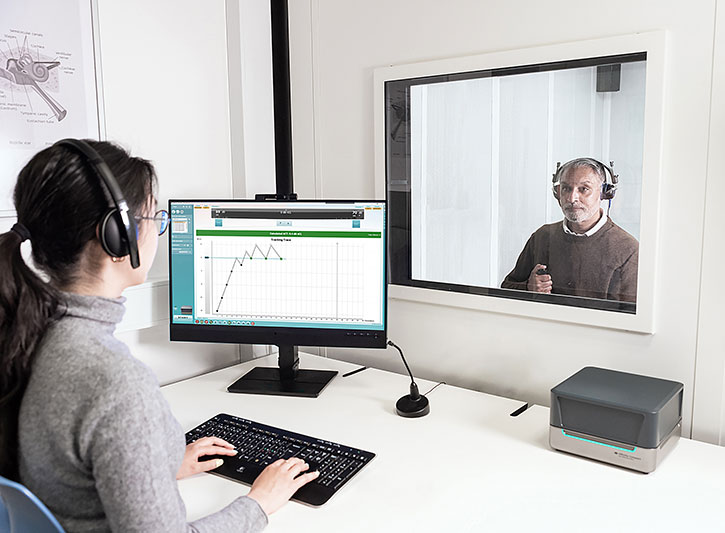
Using the same equipment as pure tone audiometry and the familiar Hughson-Westlake procedure, the ACT test is intuitive for both clinicians and clients, with 93% of HCPs reporting it can easily be integrated into clinical routine (Vatti et al., 2025).
6. Clinicians overwhelmingly recommend ACT
The study by Vatti et al. (2025) covered multiple countries, 30 HCPs, and approximately 3000 clients – and the results displayed not only acceptance, but endorsement:
- 89% would recommend ACT to peers
- 85% felt more confident in hearing aid recommendations when using ACT
- 89% said it improved communication with clients and their significant others
7. ACT reveals hidden hearing difficulties missed by standard tests
ACT validates client complaints that traditional measures can overlook. For example, a clinical study by Bennett et al. (2024) at Henry Ford Health showed that:
- About 30% of clients with normal audiograms and hearing-in-noise complaints had elevated ACT scores.
- 35% of clients with excellent word recognition still showed contrast deficits.
Anna Linda Gudmundsdottir, a Registered Audiologist/Nurse from Iceland and user of the ACT test, shares similar experiences in her clinic:

8. ACT is backed by research
The Interacoustics Research Unit (IRU) is the research center behind the development of ACT. Based on well-established spectro-temporal modulation (STM) principles, ACT is supported by years of research and now validated through large-scale clinical use.
Read more: ACT research origins
The takeaway: A quick and simple test with a big clinical impact
Two and a half years after its launch, the ACT test is already highly valued by clinicians for its speed, simplicity, and its natural integration into the clinical workflow. Most importantly, it helps you see beyond the audiogram – leading to more confident fittings, better counseling, and improved client outcomes.
If you’re looking to strengthen your diagnostic toolkit and deliver more personalized care, ACT is a powerful next step. Available with the Affinity Compact, Callisto™, and Equinox Evo audiometers from Interacoustics.
Related courses
References
Bennett, E., Marino, J., Stach, B., Ramachandran, V., & Faulkner, K. (2024). Clinical feasibility of the Audible Contrast Threshold (ACT) test. The Hearing Review.
Vatti, M., Ratanjee-Vanmali, H., Laugesen, S., & Ghamkar, M. (2025). ACT™ in action: Enhancing client care with the Audible Contrast Threshold (ACT) test. Clinical experiences and the value of integrating the ACT test into clinical practice.