High Frequency Audiometry
Description
Table of contents
- What is high frequency audiometry?
- Why perform high frequency audiometry?
- Required equipment
- High frequency audiometry research
What is high frequency audiometry?
High frequency audiometry, also known as extended high-frequency (EHF) audiometry, refers to performing pure tone audiometry at frequencies above 8 kHz. This is performed using the same procedure as normal air conduction audiometry.
| Type of audiometry | Frequencies |
| Standard | 250 Hz to 8 kHz |
| High frequency | 8 kHz to 20 kHz |
Table 1: Frequencies tested in standard audiometry vs high frequency audiometry.
Performing high frequency audiometry requires the use of specialized headphones and calibrated test signals at these extended frequencies.
Why perform high frequency audiometry?
The frequency range for standard audiometry allows for testing of the region of hearing where most speech information lies. High frequency audiometry has a different role; rather than intended to measure hearing levels that correspond to speech information, the ultra-high frequencies can provide valuable diagnostic information.
This is particularly noteworthy as cochlear damage often presents in the ultra-high frequencies before presenting in the standard frequency range. As a result, high frequency audiometry can allow for the detection of problems earlier than would be possible via standard audiometry alone.
Candidate patient populations for high frequency audiometry
High frequency audiometry can be helpful when assessing patients with a history of:
- Tinnitus
- Ototoxicity
- Noise exposure
- Acoustic traumas
- Radiation therapy near the temporal bone
This is because many of these conditions will present with early high frequency cochlear damage that would not otherwise be detected by standard audiometry. High frequency audiometry can help inform ototoxic medication dosages to minimize harmful side effects of the medication. Tinnitus pitch is often reported above 8 kHz, with hidden high frequency hearing loss potentially responsible for the symptoms.
Accommodating for the future of hearing devices
High frequency audiometry is an increasingly relevant and popular assessment. Advances in hearing device technology such as receiver-in-the-canal devices (RICs) have improved the value and benefit of providing amplification in the high frequencies, allowing for more accurate delivery of high frequency sounds into the ear canal.
There are also evolving trends in prescription formulae and hearing aid fitting technologies which will continue to promote hearing device programming into higher frequencies in the future.
Required equipment
- Patient response button
- Audiometer with high frequency license
- Calibrated high frequency audiometry transducer
- A very quiet environment (high frequency thresholds are more susceptible to ambient noise)
Note: With Interacoustics audiometers, high frequency audiometry is only available if the optional high frequency license is installed on the instrument. If the license is not installed or if the headset is not calibrated for high frequencies, the HF phone button does not appear on the audiometer, and the software suite will dim the HF and HFz buttons.
Interacoustics software suite display
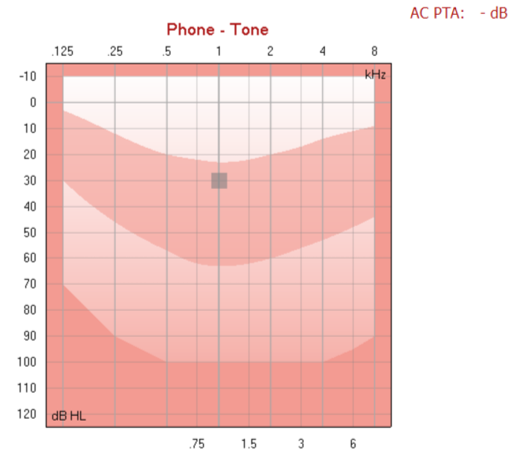
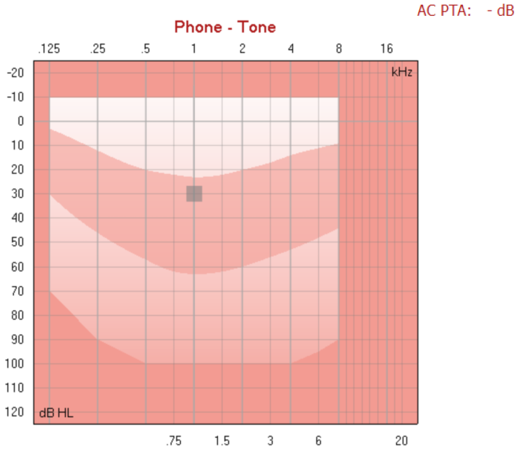
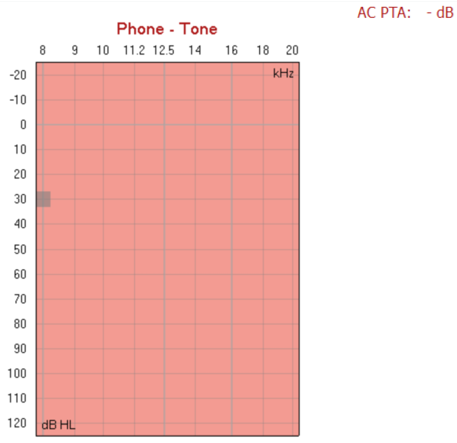
Within the Affinity/Equinox Suite, there are different display options available (Figures 1-3).
Test procedure within Interacoustics software suite
- Open the Affinity/Equinox Suite and select the AUD tab to enter the audiometry testing screen.
- Select a suitable protocol with audiometry enabled.
- Select the Output to be HF Phone.
- Select the Input to be Tone.
- Select either the HF or HFZ icons to activate the high frequency audiogram and testing function.
- Instruct the patient and perform high frequency audiometry in the same way as you would perform normal air conduction audiometry.
High frequency audiometry research
The following guidance has been derived from large datasets (Luengrungrus et al., 2024, Wang et al., 2021, ISO based 2024 modeling) and provides expected threshold ranges (Table 2). It is important to note that exact norms vary by population, and it is recommended to use local norms when available.
| Age | Frequency (range) | Expected threshold | Upper frequency limit of hearing |
| 18 to 40 | 9 to 14 kHz | 20 dB HL or less | 16 to 20 kHz |
| 18 to 40 | 16 kHz | About 30 dB HL | 16 to 20 kHz |
| 40 to 70 | 9 kHz | 20 dB HL | 16 kHz or less |
| 40 to 70 | 14 to 16 kHz | Up to 70 dB HL | 16 kHz or less |
Table 2: Normative data for high frequency audiometry.
2026 review into high frequency audiometry
A review in 2026 authored by Douglas Beck, Au.D. and colleagues highlighted shortcomings of the traditional 0.25 to 8 kHz audiogram, given that human hearing extends to 20 kHz (Beck et al., 2026). The article argues that only performing audiometry up to 8 kHz risks missing some of the earliest and most clinically meaningful signs of auditory damage, especially in the basal region of the cochlea, which processes high frequencies and is highly vulnerable to noise, aging, and ototoxicity.
Many patients who present with a “normal” audiogram up to 8 kHz still report symptoms such as difficulty hearing in noise, tinnitus, increased listening effort, and sound‑localization problems. The article emphasizes that these symptoms often reflect high‑frequency or suprathreshold deficits, which are not captured by testing the standard frequency range and when relying solely on pure tone audiometry.
Early deterioration above 8 kHz can occur even when thresholds below 8 kHz are intact, meaning clinicians may miss the true source of the complaint if high frequency audiometry testing is not included.
US National Health and Nutrition Examination Survey
The US National Health and Nutrition Examination Survey (NHANES) identified early-onset sub-clinical hearing loss (SCHL) in 227 million people, or 80% of U.S. adults, using high-frequency pure-tone averages (Dragon et al., 2023). This indicates that when high frequency audiometry is included in testing, the prevalence of hearing loss is far greater than estimates based on traditional audiograms and is evident decades sooner.
Clinical takeaway
Combining high frequency audiometry with the suprathreshold Audible Contrast Threshold (ACT™) test meaningfully expands the diagnostic value of the audiological test battery while adding very little extra time to appointments. Three audiometers from Interacoustics can perform both types of testing (Table 3).
| Audiometer | High frequency audiometry range |
| Affinity Compact | Up to 20 kHz |
| Callisto™ | Up to 16 kHz |
| Equinox Evo | Up to 20 kHz |
Table 3: Audiometers from Interacoustics that can perform both high frequency audiometry and the ACT test.
High frequency audiometry detects early cochlear changes, including subtle outer hair cell dysfunction, auditory nerve stress, and early synaptopathy, which often arise long before conventional 250 Hz to 8 kHz thresholds shift. These high frequency changes are strongly linked to functional difficulties such as speech-in-noise challenges, tinnitus, and listening effort, which are complaints that frequently persist despite a normal audiogram.
The ACT test complements this by assessing suprathreshold auditory processing, revealing how effectively the auditory system handles real world, complex listening tasks beyond simple tone detection. This layer of assessment captures neural and processing deficits that standard threshold testing cannot, helping explain why patients with “normal hearing” may still struggle in noisy or demanding environments.
Together, high frequency audiometry combined with the ACT test provides a dual level view: High frequency thresholds identify early peripheral/cochlear dysfunction, while ACT highlights functional, real world listening deficits.
This combined approach allows clinicians to better match symptoms to measurable findings, guide earlier and more tailored interventions, monitor subtle changes over time, and support improved long term outcomes, all with minimal additional testing time.
Read more: Audible Contrast Threshold (ACT™) Test: A Complete Guide
References
Beck, D. L., Fling, M., & Darrow, K. N. (2026, January 6). Why extended high-frequency (EHF) hearing assessments are necessary.
Dragon, J. M., Grewal, M. R., Irace, A. L., Garcia Morales, E., & Golub, J. S. (2023). Prevalence of Subclinical Hearing Loss in the United States. Otolaryngology--head and neck surgery : official journal of American Academy of Otolaryngology-Head and Neck Surgery, 169(4), 884–889.
Luengrungrus, K., Thanawirattananit, P., & Teeramatwanich, W. (2024). Normative Data of Extended High Frequency Audiometry in Normal Hearing Subjects with Different Aged Groups. Audiology Research, 14(6), 1084-1092.
Wang, M., Ai, Y., Han, Y., Fan, Z., Shi, P., & Wang, H. (2021). Extended high-frequency audiometry in healthy adults with different age groups. Journal of otolaryngology - head & neck surgery = Le Journal d'oto-rhino-laryngologie et de chirurgie cervico-faciale, 50(1), 52.
Presenter