Pediatric (PED) Noise
Description
Table of contents
- Performing behavioral audiometry in children
- What is pediatric (PED) noise?
- Why use PED noise?
- How to access PED noise
Performing behavioral audiometry in children
Performing behavioral audiometry in children becomes possible at around the age of 7 months through the use of visual reinforcement audiometry (VRA). VRA is a passive conditioned test whereby you teach the child to turn their head in response to a sound presentation and then reward them with a visual reinforcer such as a toy or video image.
At around 2 and a half years of age, most typically developing children progress on to performing play audiometry. This is a more deliberate co-operative activity involving the child performing an action upon hearing the sound stimulus. For children with complex needs or developmental delays, VRA may continue to be more appropriate into older years.
Frequently, both VRA and play audiometry begin via free field presentation, as introducing headphones or insert earphones too soon can be upsetting or distressing for the child. Whilst free field audiometry has its limitations in not providing ear-specific information, it can be hugely beneficial in assessing the child’s overall hearing levels. To avoid standing waves, you should not use pure tone stimuli in the free field and instead select warble tones or other stimuli.
With the passive / conditioned nature of VRA, and to an extent play audiometry in the youngest of children, it is often found that tonal stimuli are not interesting enough to captivate or maintain the child’s attention. As a result, it has been necessary to develop alternative stimuli which are suitable for threshold estimation and able to both capture and sustain the child’s attention for a long enough duration to obtain a range of thresholds.
What is pediatric (PED) noise?
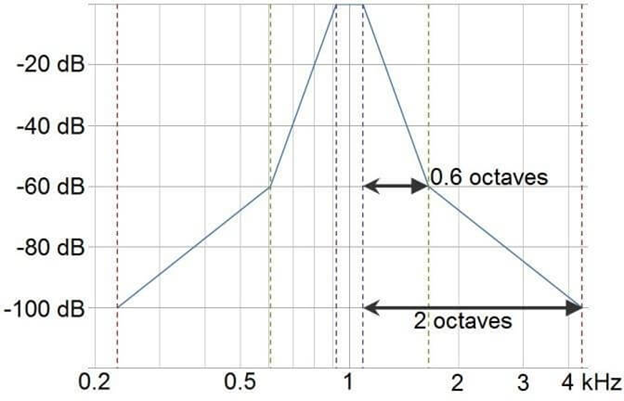
PED noise is a specialized stimulus for pediatric testing. In terms of frequency specificity, it sits between a pure or warble tone and narrowband noise (NBN), providing a more interesting stimulus than warble tones but without the poor frequency specificity of narrowband noise.
The PED noise stimuli are bands of noise that use steep filter slopes to provide ultra-narrow bands of frequencies suitable for threshold estimation. PED noise stimuli are available across the full audiometric range and are calibrated in dB HL.
Figure 1 displays the spectrum of the 1 kHz PED noise stimulus.
Why use PED noise?
PED noise is recommended when testing children who are not engaging with or responding to traditional pure tones or warble tones. Frequently, this occurs when these tonal stimuli are not interesting enough to capture or hold the child’s attention. Noise-like stimuli are often found to be more successful at being “attention-grabbing” as they contain a broader range of frequencies.
Narrowband noise is not recommended for threshold estimation due to the poor frequency specificity within these stimuli (1/3 octave bandwidth). However, these sounds can be useful for initial conditioning for tests such as VRA and play audiometry.
PED noise provides the ideal compromise, offering a noise-like stimulus which is captivating to children without sacrificing frequency specificity as occurs with narrowband noise.
The below images offer a comparison of a 2 kHz warble tone, narrowband noise, and PED noise, overlaid on an audiogram showing a steeply sloping loss.
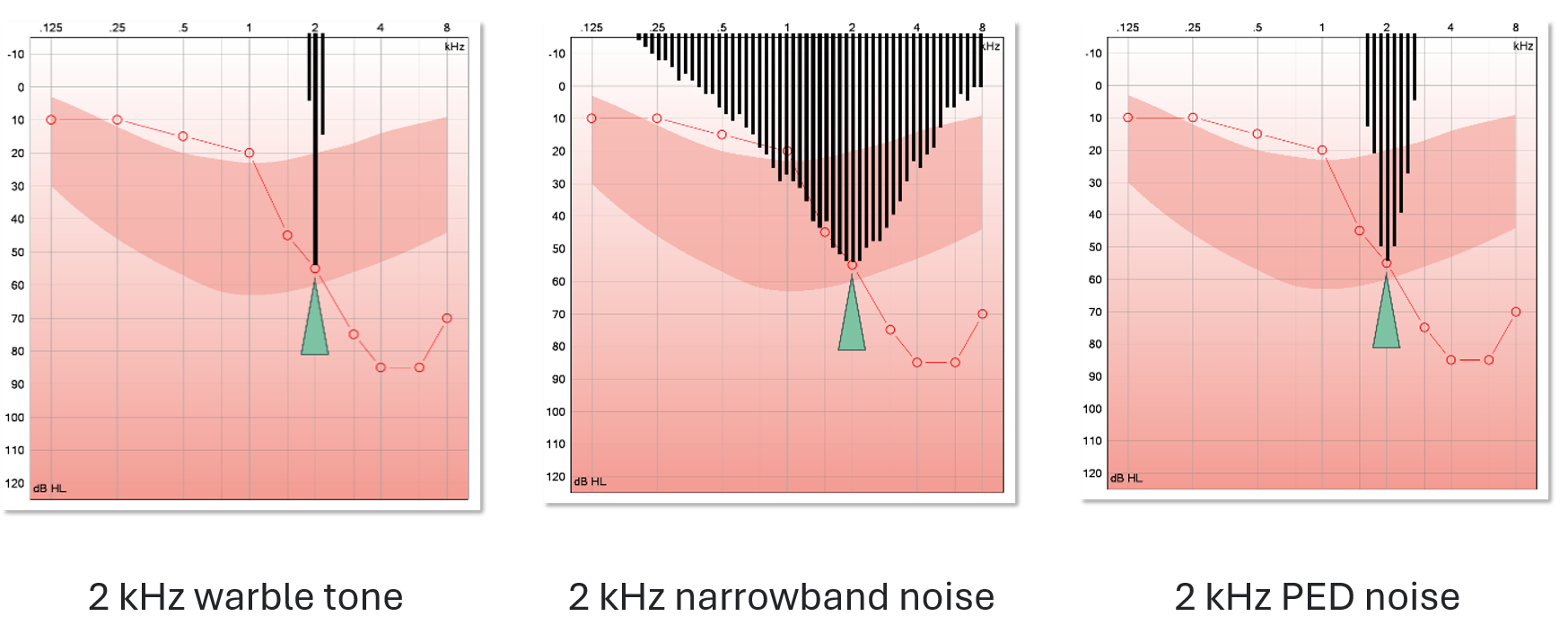
As shown above, using the 2 kHz narrowband noise stimulus risks stimulating the better hearing region at 1 and 1.5 kHz. This can result in the patient responding positively to the 2 kHz stimulus despite it not being truly audible at the 2 kHz region on the basilar membrane within the cochlea, a phenomenon known as off-frequency listening.
The steeper slopes of the PED noise stimulus offer much improved frequency specificity compared with narrowband noise, reducing the likelihood of erroneous responses generating from off-frequency listening.
How to access PED noise
PED noise is available on the Affinity Compact and Equinox Evo audiometers and you can access it via the Affinity/Equinox software suite.
Steps:
- Select the AUD tab to perform audiometry.
- Select either a protocol with audiometry available or the pediatric test screen.
- Under Input for Channel 1, select PED. You can use PED noise via all available transducers: headphones, insert earphones, bone conduction, or free field delivery.
- Use the audiometer controls to select the desired frequency for testing and perform regular audiometry.

Summary
It is important to have access to a range of stimuli for behavioral audiometric testing in children. You can use pure tones via headphones, inserts, or bone conduction transducers, but warble tones are often preferred as a more interesting stimulus.
In the free field, you must not use pure tones to avoid standing waves, resulting in warble tones being the default stimulus. However, when warble tones are not interesting enough to capture and keep a child’s attention, PED noise is the obvious next choice for threshold estimation, offering appropriate frequency specificity whilst being “attention-grabbing”.
To learn more about performing high-quality behavioral audiometry in children, visit our resources on pediatric audiometry.
Presenter